This article is an expanded version of what began as a much shorter (and snarkier) movie review. I was surprised to find the making-of documentary on YouTube and even more surprised at how earnest everyone involved was. After watching the movie three times and learning the back story behind the film, I still can't decide whether or not I would recommend other people watch the movie.
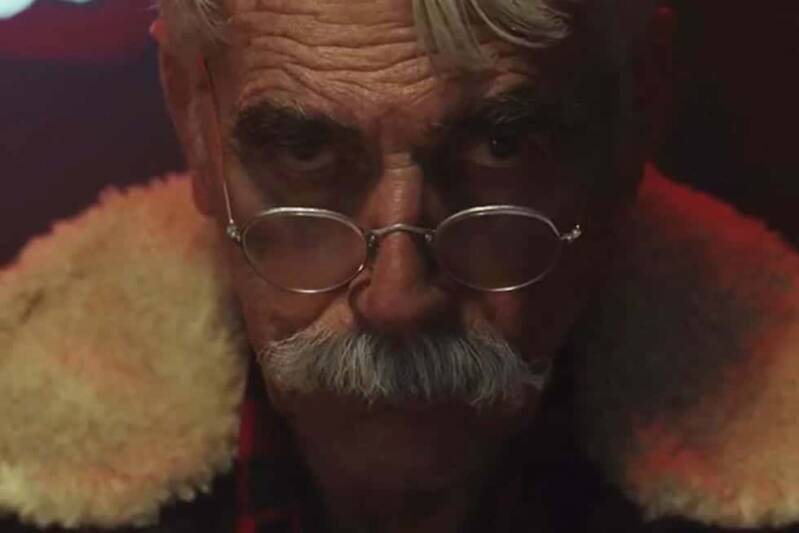
Spoiler Alert: Sam Elliott Can't Save This Movie
For reasons that remain unclear, Sam Elliott decided to follow up his critically acclaimed performance in 2017's The Hero with a somewhat less acclaimed performance in The Man Who Killed Hitler and Then the Bigfoot. The movie features improbable action sequences, cringey dialog and a plot hole in the epilogue so large you could drive a semi through it. A 74-year-old Sam Elliott taking out three would-be carjackers in less than two minutes is almost believable, but the hand-to-hand combat scene with "the Bigfoot," not so much. (I will continue to refer to the Bigfoot with a capital B out of deference to the source material) An in-his-prime Sam Elliott could maybe take down the Bigfoot, a septuagenarian Sam Elliott? Not so much.
Spoiler alert: while the title of this movie already gives away the endings of the movie's two major plotlines, I will be discussing some of the finer details as well. Should you decide to watch the movie before reading on, I suggest you grab three beers and a bowl of popcorn before hitting play on this 90-minute misfire.
What Could Have Been
The maddening thing about this movie is that each of the plotlines could have been expanded into its own (presumably better) movie.
The killing Hitler storyline is based on the conspiracy theory claiming that the Nazi party had multiple lookalike Hitlers that moved around Europe to help keep the real Hitler safe. Part of 70-something Calvin's bitterness in old age is that he did not kill the real Hitler, but one of the lookalikes. This is enough to build an entire movie around.
The bigfoot plotline is also ripe for expansion. There is a lot of information about the Bigfoot dropped into the dialog to move the story along. Instead of rushing through this information in what amounts to an explanatory monologue, if you build scenes to get the information across, before you know it you will have a feature length film.
A New Killing Hitler Movie
In the making-of documentary on YouTube, writer/director Robert D. Krzykowski says that he started out just writing a story about killing Hitler, but on page 10 of the script, Hitler was dead and there was nowhere else to go with the story.
What?
How about adding scenes that expand on Calvin's military training and how he became a renowned tracker? (See Chekhov's gun in act one principle for when this fact is brought up later in the killing the Bigfoot part of the movie). Why not expand the love story portion of the movie? What about adding scenes about the aftermath of killing Hitler?
In spite of the ham-fisted approach to this part of the movie, this storyline actually works pretty well. But just as you get drawn in, it abruptly ends. Lots of opportunities for improvement if there is ever a direct to streaming remake of this part of the movie.
A New Killing Bigfoot Movie
This part of the movie consists of federal agents explaining (somewhat plausibly) why they are recruiting a 74 year old man to kill the Bigfoot followed by a montage of Calvin tracking the Bigfoot through the woods and ending with the killing promised in the title.
Krzykowski doesn't give us enough to chew on to truly engage in this part of the movie. The dialog suggests that Calvin may have had interactions with the bigfoot in the past but never develops that part of the storyline. It is also mentioned in passing that Calvin has great tracking skills and suggests that the Bigfoot may be the last of his kind.
Instead of rushing through these plot points to justify the movie title, Krzykowski should have filled in the storyline gaps and created a standalone killing the Bigfoot script instead (but maybe come up with a title that doesn't give away the end of the movie).
But Maybe I Am Looking At It The Wrong Way
To be fair, it can be argued that The Man Who Killed Hitler and Then the Bigfoot is one of those movies that is so bad it's good. There are plot holes, ridiculous action scenes and scenes with dialog that tries desperately to sound clever and profound but mostly comes across as ludicrous.
In the killing Hitler part of the movie, for reasons not fully explained, a Russian soldier uses a straight-edge razor to shave Calvin's beard. The Russian goes on and on about what Russian folklore says it means if he accidentally cuts Calvin while shaving him. Krzykowski is clearly trying to channel his inner Tarantino here, but Tarantino is having none of it. If you took a shot of vodka every time the Russian pauses for dramatic effect in the middle of a sentence, you would be passed out before the movie got to the third act.
In the making-of documentary, Krzykowski says that it took 12 years to get the film made; certainly enough time to refine the story and tighten up the dialog. Maybe The Man Who Killed Hitler and Then the Bigfoot is everything it should be. The cast and crew have nothing but good things to say in the making-of documentary and I am big enough to admit that maybe I am wrong in my criticism of the movie.
However, I will still patiently await the arrival of two new features expanded from each half of the movie.